Wednesday, August 1, 2012

Slatted Bottom Boards

Mark invested in some slatted bottom boards this year, to help with ventilation.

Some beekeepers think it's an unnecessary expense.

We like them for the following reasons:

  • bees don't beard on the front of the hives -- they can congregate down below the brood chambers. If you have an urban bee yard and it freaks out your neighbors to see bees bearding ("They're SWARMING!"), slatted bottom boards might be a good option for you.
  • ventilation. Mississippi is hot. We have screens on top to help with temperature, but the extra ventilation may help us cut down on common bee diseases, like Nosema.
  • the bees seem calmer. Maybe it's because they don't feel as crowded, but our colonies on the slatted bottom boards don't seem as aggressive.
  • we can still use oil traps for pest control, rather than chemicals.
Here are two pictures.


The hive entrance is to the right.

Friday, July 27, 2012

The Hilts' Visit to Bee Hill

Some dear friends stopped by as part of their vacation. I've known Becky & Jay since we were all in college together at FC. They still live in Florida, though we're trying to convince them to relocate here.

We took them to Stafford's Big Burger in West Point for a Mississippi culinary cultural experience: fried pickles and fried green tomatoes. Oh, and I had a strawberry shake for supper. Annabelle really liked the fried pickles. My kind of kid!

They wanted to see the bees, so Mark got them all suited up and Becky took my camera. The bummer was that it was set on manual focus. Boo.

Here are a couple of pictures from their sunset visit to Bee Hill.


We really need to invest in some kid-sized bee gear!

The next morning we fed them deer steak, deer sausage, biscuits and eggs.

Then Dougray had some target practice.

It's a Redneck Vacation Extravaganza, y'all! Come & see us!

Saturday, July 21, 2012

Bee Yard Inspection at Prairie Wildlife

Yesterday Mark drove out to Prairie Wildlife in West Point to add honey supers in anticipation of the soybeans blooming. He was upset to find that since his last visit two or three of the hives' lids had been blown off in the recent storms. We have no idea how long the bees had to put up with all of that light, wind, and rain! Not their favorite way to live.

So today, after the rain storm and power outage (!) he loaded the 4-wheeler onto the trailer, put heavier lids in the back of the truck, and we headed out. Thankfully, it was only 75 degrees! Not that it lasted . . .

We looked through all of the hives except the "tower of power" on the end. For the most part, they're doing well, though growing more slowly than we anticipated. Most are not generating excess honey stores yet.

We found one hive that was queenless but loaded with honey and pollen. We combined it with one of the hives that had been exposed to the elements, but still had a healthy queen. We hope they'll join forces and create a strong, healthy colony.

It was nice to be out with Mark, working the bees together. I've missed it.

Photo highlights:

It wasn't smoky . . . my lens fogged up when I got out of the truck. ;-)
All of the hives, before we inspected.

Snack time!

If you can't see the queen here, folks, I can't help you.
These bees are making use of every cell -- pollen is interspersed with uncapped and capped brood.

Pretty, fresh brood comb. Well done, Queenie!


Newspaper combining a healthy colony with a queenless colony.

Ah, Summer!

We've been busy, as have the bees!

After inspecting Bee Hill, Mark spent the 4th of July painting honey supers. He anticipates a big harvest.

We're in the final stages of redesigning our logo and honey labels, and I'm *very excited!* I'll give you a sneak peak when everything is finalized.

Today I met the new Extension apicultural specialist, that is, beekeeping expert. I've got a news release about him coming out this week at work, which I'll post here after it's out. He came to MSU from USDA's bee breeding lab in Louisiana, but has been a beekeeper since he caught his first swarm at age 8. Welcome to MS, Dr. Jeff Harris!

My garden is surviving. The hummingbirds are in constant battle over the feeders -- and we have 3! I'm selling honey in fits and starts through a couple of different Facebook pages. The spring harvest is almost gone. The soybeans are in bloom.

Tonight Mark is assembling frames to make cut-comb honey. This involves papery thin sheets of wax, bobby pins, and teeny-tiny nails.

All in all, life is good at PBBF. I hope your summer is going well, too!

Tuesday, June 26, 2012

U.S. Fish & Wildlife Service Info. on Pollinators

In support of National Pollinator Week, the U.S. Fish & Wildlife Service did a series of blog entries on pollinators. They also have a web page about pollinators and showed off the new pollinators poster, "Pollinator Pathways" by Steve Buchanan. I may have to stop by our local NRCS office and see if they have any!
Join the Conversation about Native Bees

Monday, June 25, 2012

Velcro flower petals?

Flower petals appear to be smooth, but this article discusses a study that shows the petals act like Velcro to bee feet!


Tuesday, June 19, 2012

A Visit to the Dutch Gold Facility in Pennsylvania

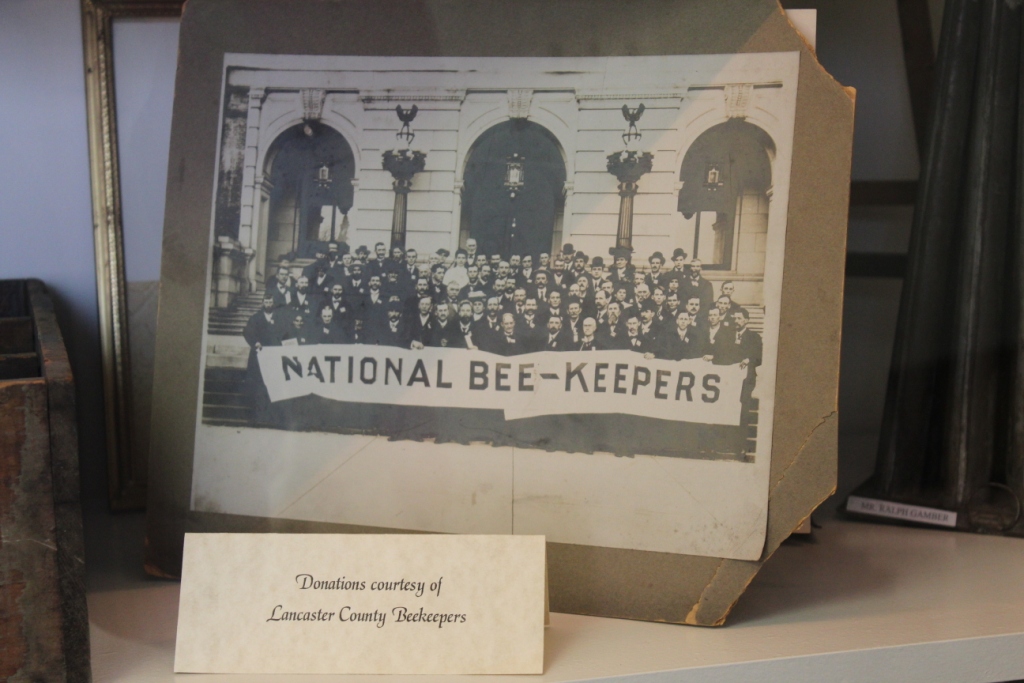
In the book Robbing the Bees (link goes to my book review) by Holley Bishop, she talks about the first honey bear container's creation leading to a family business that is known as Dutch Gold, in Lancaster, PA.

In addition to a display of historic beekeeping equipment, they sell containers and an assortment of varietal honeys. They buy honey from all over the world and stack the barrels in their warehouse. Because the honey sugars, the first step is to put the barrels in a hot room for about 3 days before pouring it into a large vat. Through a glass window we watched how they steam the honey barrels to get out all of the product. The honey is then heated to 180+ degrees, blended into one of their recipes to get the desired flavor, cooled to about 140 degrees, and piped into bottles. It's honey bottling on a scale I've never seen -- a true mechanical assembly line moving at a rapid pace.The honey has to stay hot to move swiftly through the machines.

Each bottle is weighed, labeled and boxed to be shipped. At the time we visited, they were bottling for Costco, which has its own honey label. Many grocery store chains also carry Dutch Gold honey, but under the store's own label.

Our guide assured us that they go through strict protocols to make sure the honey they buy both domestically and abroad is high quality. They send honey samples to a lab in Germany to test it for antibiotics and other impurities before they agree to purchase from any beekeeper.

It was a fascinating visit, but one that convinced me -- more than ever -- of the importance of buying local honey. Yes, super-heated honey will not sugar, is a pretty color in the jar, and will likely have a consistent, if generic, honey flavor. But the minerals and enzymes that make honey something more than liquid sugar are gone. If you go to the National Honey Board's website, you can download a free PDF about the "Reference Guide to Nature's Sweetener" to learn more.

In return for our free tour, we bought two bottles of varietal honey we don't see often: raspberry and orange blossom. Our tradition of buying honey while traveling continues -- more on the "real, local" honey we purchased in a future post.

Photo highlights:

My favorite beekeeper.

An historic photograph.

A collection of old smokers.

Skeps and hives.