

Showing posts with label pollinators. Show all posts
Showing posts with label pollinators. Show all posts
Tuesday, June 26, 2012
U.S. Fish & Wildlife Service Info. on Pollinators
In support of National Pollinator Week, the U.S. Fish & Wildlife Service did a series of blog entries on pollinators. They also have a web page about pollinators and showed off the new pollinators poster, "Pollinator Pathways" by Steve Buchanan. I may have to stop by our local NRCS office and see if they have any!

Sunday, June 3, 2012
Blueberry Pie
The delicious blueberries available this time of year are possible thanks to pollinators. Here in Mississippi we have the Southern blueberry bee to help, along with many others.
Some friends had us over Monday night, and invited us to pick blueberries to take home with us. I've been in blueberry heaven ever since.
Here is my favorite recipe for blueberry pie, from Frances Barham's cookbook, recipe by Kim Latham.
Crust for a double crust pie
2 Tbsp. lemon juice
3 cups blueberries (you can use frozen if needed)
2/3 cup sugar
3 Tbsp. cornstarch
1 Tbsp. margarine (I've used butter, and tend to use more than 1 Tbsp. -- I dollop generously!)
Sprinkle lemon juice over blueberries. Mix sugar and cornstarch together, then stir into blueberries. Put into pie crust. Dot with margarine. Cover with top crust and cut vents in the crust. Bake at 400 degrees for 50-60 minutes or until the filling bubbles and the crust is golden brown. **You may want to put a cookie sheet on the rack underneath to catch any juices that overflow. Or, you can be like me, and get to clean your oven. ;-)
Enjoy!
Keri
Call Mark if you need honey! 662-418-4422
Some friends had us over Monday night, and invited us to pick blueberries to take home with us. I've been in blueberry heaven ever since.
Here is my favorite recipe for blueberry pie, from Frances Barham's cookbook, recipe by Kim Latham.
Crust for a double crust pie
2 Tbsp. lemon juice
3 cups blueberries (you can use frozen if needed)
2/3 cup sugar
3 Tbsp. cornstarch
1 Tbsp. margarine (I've used butter, and tend to use more than 1 Tbsp. -- I dollop generously!)
Sprinkle lemon juice over blueberries. Mix sugar and cornstarch together, then stir into blueberries. Put into pie crust. Dot with margarine. Cover with top crust and cut vents in the crust. Bake at 400 degrees for 50-60 minutes or until the filling bubbles and the crust is golden brown. **You may want to put a cookie sheet on the rack underneath to catch any juices that overflow. Or, you can be like me, and get to clean your oven. ;-)
Enjoy!
Keri
Call Mark if you need honey! 662-418-4422
Monday, March 5, 2012
HD video of pollinators in action
This combination of time-lapse photography and video gives viewers a truly amazing view of the intricacies of several pollinators. Hummingbirds, bats (one carrying her young!), butterflies, flies, and of course, honey bees, are brought closer than you have ever seen them.
Enjoy!
Thanks to our friend Guy Ray for sharing!
Enjoy!
Thanks to our friend Guy Ray for sharing!
Sunday, February 19, 2012
Bumblebees featured in Southern Gardening video
In my work with the Mississippi State University Extension Service Office of Agricultural Communications, I'm privileged to meet many experts in a wide variety of fields. The horticulture specialists and Master Gardeners are among the most enthusiastic.
Recently my colleagues on the other side of the lobby compiled video footage collected over several Southern Gardening shoots to create an episode on bumblebees. It's fun to watch them working and grooming themselves (the bumblebees, not my colleagues!).
Here is the link: http://msucares.com/news/SGTV/video/2012/020812.html.
Recently my colleagues on the other side of the lobby compiled video footage collected over several Southern Gardening shoots to create an episode on bumblebees. It's fun to watch them working and grooming themselves (the bumblebees, not my colleagues!).
Here is the link: http://msucares.com/news/SGTV/video/2012/020812.html.
Sunday, October 23, 2011
Making Room for Bees
For my day job, I spend lot of time thinking about agriculture. I am sympathetic to farmers who gamble on the weather, who try to manage everything just right to get the best yield. Their inputs are high, they have little control over many of the circumstances upon which their livelihood depends, and most of the producers I've met are down-to-earth, nice folks who are thoughtful neighbors.
That said, many property owners -- whether farmers, hunters, timber investors, or none of these -- could do so much for pollinators if they would simply make room for them. Wildflowers thrive in the buffer zones, areas between plantings, creek banks, ditches, field margins, and roadsides. Richard at The Peace Bee Farmer writes poetically about the wildflower meadow they planted last year -- just one acre, but it's a haven for all sorts of winged creatures.
Mark is investigating prairie restoration projects for some land he helps manage, which would involve native wildflowers over several acres. I hope it will become a reality, not only because I think some of our bees would be very happy there, but because wild pollinators, who need all the help they can get, would find a beautiful sanctuary.
How can you make room for bees where you are?
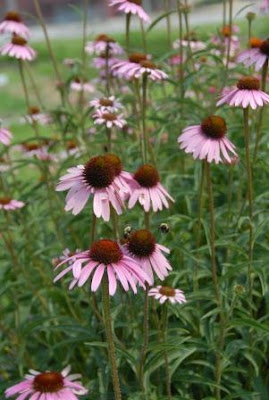
That said, many property owners -- whether farmers, hunters, timber investors, or none of these -- could do so much for pollinators if they would simply make room for them. Wildflowers thrive in the buffer zones, areas between plantings, creek banks, ditches, field margins, and roadsides. Richard at The Peace Bee Farmer writes poetically about the wildflower meadow they planted last year -- just one acre, but it's a haven for all sorts of winged creatures.
Mark is investigating prairie restoration projects for some land he helps manage, which would involve native wildflowers over several acres. I hope it will become a reality, not only because I think some of our bees would be very happy there, but because wild pollinators, who need all the help they can get, would find a beautiful sanctuary.
How can you make room for bees where you are?
- if you have unwanted bees in your house or on your property, call a beekeeper, not an exterminator
- plan this winter for your spring pollinator garden
- allow room for wildflowers on the edges of your property
- preserve creek banks by not harvesting timber or planting/harvesting crops all the way to edge. Leave a buffer zone!
- plant a prairie garden (this is from Minnesota) or wildflower meadow (this is for MS)
- take up beekeeping! Seriously, having two hives will bring you a lot of enjoyment. You don't have to be like us and expand from 6 to 22 . . . with plans to go to 50 in the spring.
- lobby for bee-friendly zoning ordinances so people in urban areas can keep bees
- work with your local garden club or school to create a pollinator garden
- plant pollinator-friendly plants -- herbs, flowers, milkweed, etc.

Tuesday, June 7, 2011
My Pollinator Photos
Recently I was in a garden with a borrowed DSLR camera. I wanted to see if I could capture some honey bees at work, but caught these two insects instead.

Fortunately, I was also in a bee yard that day. So I was able to see some honey bees too.

This last image was improved upon by my colleague Kat Lawrence and released with an article I wrote about the beekeeping shortcourse Mark & I attended last week. I'll share it when it's posted online. Hopefully we'll get some good press for these workshops and people will sign up for the one in Columbia next week.
For a short article on pollination, click here.
 | ||||||

Fortunately, I was also in a bee yard that day. So I was able to see some honey bees too.

This last image was improved upon by my colleague Kat Lawrence and released with an article I wrote about the beekeeping shortcourse Mark & I attended last week. I'll share it when it's posted online. Hopefully we'll get some good press for these workshops and people will sign up for the one in Columbia next week.
For a short article on pollination, click here.
Tuesday, May 24, 2011
100 Posts and a Pollinator-Friendly Garden
Welcome to Post 101 on the PBBF blog!
I subscribe to The Herb Companion in an attempt to figure out how to use all of the herbs I'm growing. The magazine features recipes for food, spa products, and health remedies, among other helpful articles.
They also post many of the articles online. As this author points out, one garden won't make a huge difference, but if everyone planted just a few pollinator-friendly herbs and flowers, we could help save these fragile workers.
Currently, I have borage growing from seed simply because bees are supposed to love it. I have cilantro, sage, basil, chives, pineapple sage, parsley, and rosemary too. What do you have planted for pollinators?
 Photo of a bee on borage from The Ojai Garden.
I subscribe to The Herb Companion in an attempt to figure out how to use all of the herbs I'm growing. The magazine features recipes for food, spa products, and health remedies, among other helpful articles.
They also post many of the articles online. As this author points out, one garden won't make a huge difference, but if everyone planted just a few pollinator-friendly herbs and flowers, we could help save these fragile workers.
Currently, I have borage growing from seed simply because bees are supposed to love it. I have cilantro, sage, basil, chives, pineapple sage, parsley, and rosemary too. What do you have planted for pollinators?

Sunday, April 17, 2011
Growing More than Bees
On Thursday, Mark bought plants at the MSU Horticulture Club's annual plant sale. He found a helpful student who sold him everything from pineapple sage to a t-shirt for me. We got up Saturday morning ready to plant. The only remnant of last year's herbs is sage. The mixture of basil seed I planted has sprouted. I love seeing new life push its way through the soil!

Considering the dog ate the first parsley I'd planted (purchased at the Everything Garden expo), I opted to put the parsley in a raised bed far from the porch where he likes to hang out with Sarah. Let's hope cilantro and lemon basil are less to his liking!

Out in the raised beds, we planted salad tomatoes (a sister to the one already planted, but the greenhouse resident already had small fruit growing on it!), Early Treat and Better Boy tomatoes, okra, and zucchini. I'm sure this photo documents the last time the entirety of both zucchini plants will fit in the same photograph.


We also planted some flowers designed to make pollinators happy, including lantana. I attempted to transplant some borage seedlings, but today they're looking limp and distressed. Time will tell. Bees are supposed to love borage blossoms, so I hope these survive!

What are you planting this spring?

Considering the dog ate the first parsley I'd planted (purchased at the Everything Garden expo), I opted to put the parsley in a raised bed far from the porch where he likes to hang out with Sarah. Let's hope cilantro and lemon basil are less to his liking!

Out in the raised beds, we planted salad tomatoes (a sister to the one already planted, but the greenhouse resident already had small fruit growing on it!), Early Treat and Better Boy tomatoes, okra, and zucchini. I'm sure this photo documents the last time the entirety of both zucchini plants will fit in the same photograph.


We also planted some flowers designed to make pollinators happy, including lantana. I attempted to transplant some borage seedlings, but today they're looking limp and distressed. Time will tell. Bees are supposed to love borage blossoms, so I hope these survive!

What are you planting this spring?
Tuesday, February 22, 2011
National Geographic's Pollinator Slide Show
Generally I think in very simple terms: pollinators = insects. While that's true, this slide show from National Geographic beautifully illustrates the wide variety of creatures who help spread pollen from bloom to bloom. Honey bees get a couple of photos, including one showing bees with the evil Varroa mites attached.
Subscribe to:
Posts (Atom)